
Industry Trends Filed 29 Sep 2026 · 01:55
Twenty-two names in the smaller type: how comedy festivals pay support acts
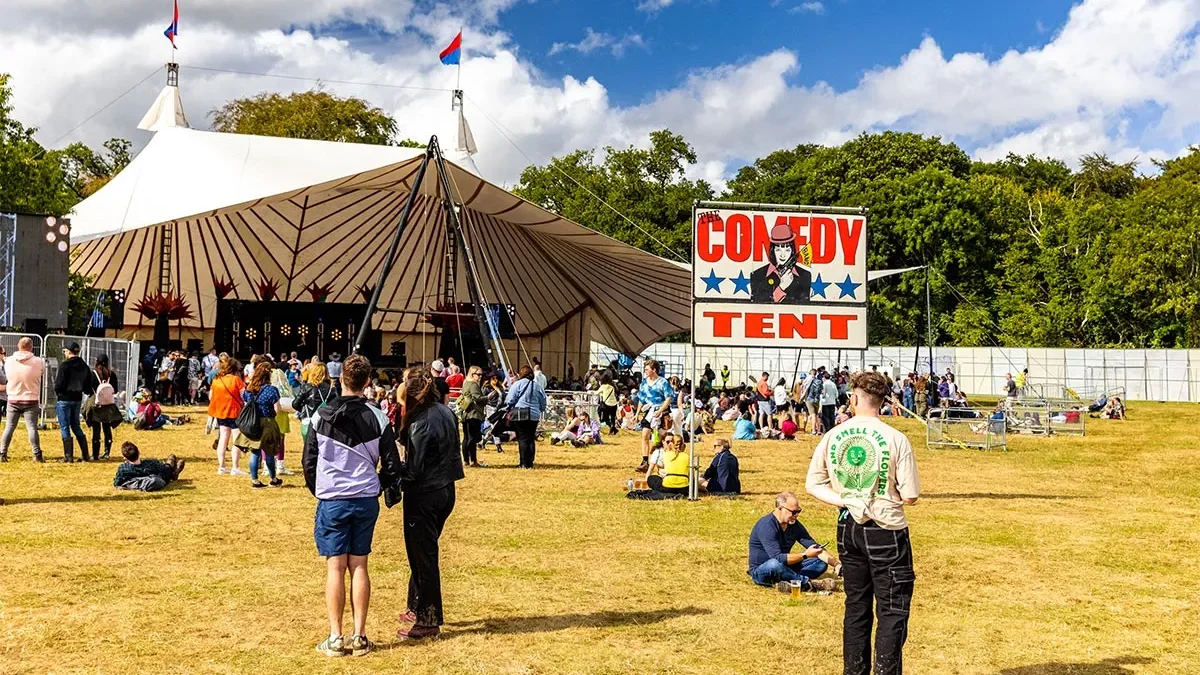
Twenty-two names in the smaller type: how comedy festivals pay support acts
On Saturday 3 October, Ed Gamble headlines a warehouse complex in Peckham. Three other comics get paid to be on that bill with him: Jen Brister, Al Nash and Josephine Lacey. Do the same count down the rest of the Peckham Playground line-up and you land on 22 support slots across seven shows in five days. They are filled by 21 comics, because Chloe Petts is on twice. She opens for Dara O Briain on the Thursday and for Tim Key on the Sunday afternoon. That is either very good agenting or somebody at Show And Tell just likes her, and honestly both are fine.
Every one of those seven bills is built the same way: a single headliner plus three support slots, bar one. Joel Dommett takes Vittorio Angelone, Elis James and Janine Harouni. O Briain takes Jake Lambert, Gbemi Oladipo, Elouise Eftos and Petts, the only four-support bill of the week. Eddie Kadi has Michelle de Swarte, Jeff Innocent and Thanyia Moore. Sara Pascoe has Bridget Christie, Sam Nicoresti and Tadiwa Mahlunge on the Saturday matinee. Tim Key’s Sunday matinee has Julia Masli, Phil Ellis and Chloe Petts. Fern Brady closes the festival on the Sunday night with Sarah Keyworth, Paddy Young and Esther Manito. No mixed bills, no compere-plus-four club format, no open spot: one name on the poster, then three more in smaller type underneath, or four in O Briain’s case.
That structure is worth staring at, because comedy festivals are where a lot of the autumn’s bookable paid work now lives. The weekly club night is still there, and clubs like the ones that reopened at Banana Cabaret’s Balham room are still doing the job. But a five-day festival with seven shows hands out 22 support fees in one go, on one poster, in one building. Getting onto one of those is a conversation in June between a producer and an agent, and the comic often finds out after it’s been settled.
Where is Peckham Playground and when does it run?
Peckham Playground 2026 runs from Wednesday 30 September to Sunday 4 October at Copeland Park in Peckham, south London. There are seven shows across the five days, tickets start at £20, and Tim Key’s Sunday afternoon show starts at £25. The festival’s own listings put food and drink vendors on from 6pm, with the evening shows starting at 7.45pm. For the two matinees it’s vendors from 3pm and a 4pm start. It’s in its third year, it’s produced by Show And Tell, and it’s one of three UK comedy festivals opening in the same week.
The site itself sits, in the festival’s words, “Just off Rye Lane, in the heart of Peckham’s cultural quarter”. It’s a lovely sentence that does not address where you are supposed to put a car. Copeland Park’s largest dry hire space is Unit/08. The venue describes it as “A huge 11,500 sq ft warehouse, Unit 08 is the largest dry hire venue in Peckham”. What nobody publishes is the seated capacity in a comedy configuration, so I’m not going to pretend to know how many bums that is. Square footage will tell you the room is big and nothing at all about the door split.
Chortle’s weekly listing called it “Copeland Park becomes the Peckham Playground, a major five-day comedy festival in the increasingly hip London district”. That’s the sort of phrasing that makes a comic who lived there in 2011 put their head in their hands.
Southport runs 17 days in a heated marquee
Two hundred and fifty miles north, Southport Comedy Festival opens on Friday 2 October and runs to Sunday 18 October. Its own site says it’s “back in 2026 for its 15th year” and promises “17 days of laughter”. It also confirms the format that matters here: “This year’s festival will be staged once again in a giant luxury heated and seated marquee in the beautiful grounds of Victoria Park.” It runs in association with Halliwell Jones Kia Southport, which tells you something about how a seaside festival of this size gets underwritten.
British Comedy Guide’s 2026 listing names Paul Merton, Alex Lowe, Jason Manford, Mick Miller, Paul Sinha, Jason Byrne, Henning Wehn, Suki Webster, Brendan Riley, Gary Delaney, Seann Walsh, Mike Wozniak, Adam Kay, Jimeoin, Steve Gribbin, Scott Bennett, Brennan Reece, Clayton Jones and Laura Smyth. That’s a marquee full of touring headliners across 17 days, where Peckham has seven curated bills across five, and the model is closer to a venue hire: book shows that are already on the road, then sell seats in Victoria Park for as long as the heaters hold out in the middle of October.
It also shows how fast a line-up becomes the story. Chortle’s 27 September column noted that on the announced bill “the only woman in the whole line-up is Suki Webster, appearing with hubby Paul Merton as part of their improv tour”. After publication, Chortle added a note: “After this piece was published, the festival pointed out that Manford is being supported by Hayley Ellis, that Laura Smyth was due to attend before rescheduling her tour, and two of the eight new comedian of the year finalists are women.” Put the two side by side and the answer to the criticism turns out to have been the support acts and the competition finalists, none of whom made it onto the announcement.
What 272 comedians told the Live Comedy Association
None of this is happening in a healthy year. The UK Live Comedy Sector Survey was run by the Live Comedy Association with the Centre for Comedy Studies Research and British Comedy Guide, and published on 4 February 2026. It found that the average number of gigs per comedian had fallen to 2.54 a week from 3.2, and that average annual turnover fell 21 per cent to £21,143 from £26,778. It had 272 respondents, 63 per cent of them comedians. Seventeen per cent earned nothing at all from comedy, up from seven per cent the year before, and nearly three-quarters now need a second job. We covered the gig-frequency collapse when UK comics dropped to 2.5 gigs a week, and the festival boom sits directly on top of that number.
The organisations are having it worse than the acts in percentage terms. Average turnover for comedy organisations in the same survey fell from £962,213 to £527,296. One respondent, quoted anonymously in the survey coverage, put the fee problem bluntly: “Fees need to increase across the board. Smaller promoters are making more money than the comics as a standard now.” That one stayed anonymous, which tells you the respondent would still like the gigs. On publication day, eight venues pledged support for the Stand Up And Give Fund: Komedia, The Stand, The Glee Club, The Bill Murray, The Frog & Bucket, Leicester Square Theatre, The Museum of Comedy and Soho Theatre.
The policy push is running alongside it. On 1 September, 47 MPs signed an LCA letter to Culture Secretary Lisa Nandy. It asked the government to recognise grassroots live comedy alongside grassroots live music, and to include it in VAT and business rates discussions. The other asks: fund independent research into the sector, explore extending the live music arena levy to comedy, and consider a fan-led review. Sixteen more supporters couldn’t sign because of Parliamentary protocol. We wrote that up when 47 MPs signed the grassroots comedy letter, and the arena levy ask connects to the £1 ticket levy already running in music.
“The support we are receiving from politicians across the political spectrum is fantastic and the timing of this letter’s publication is crucial.”
That’s Jessica Toomey, LCA chair, quoted by Chortle on 1 September. Timing is the word doing the work there. In July, the Big Difference Company submitted a serious incident report to the Charity Commission over the financial difficulties behind Leicester Comedy Festival, an organisation that later went into liquidation with nil assets against £184,510 owed. A charity festival and a commercially produced one run on different money, which is how October arrives with 22 supports booked into a Peckham warehouse and £184,510 of Leicester’s debts sitting with a liquidator.
Fifty-three shows and one outlier in Altrincham
The third festival opening that week is the one that doesn’t use the format at all. Women in Comedy Festival runs 1 to 11 October with, per its own site, “53 shows.” across “6 venues. all in the Northern Quarter of Manchester”, and Chortle’s listing adds “plus an outlier in Altrincham”. (The outlier is a Metrolink ride out of town, which in Manchester counts as a different festival.) Fifty-three shows means a programme: stand-up hours, sketch, compilations, the lot. A comic gets on it by having a show of their own, which is a different favour to ask than 15 minutes in smaller type under someone who’s on the telly.
That’s the split worth watching across next year’s comedy festivals. One route asks what you can sell on your own, the other asks whether a headliner’s audience will accept you for 15 minutes before the interval. They reward different things, and only one of them gets easier the more clips you have. Josephine Lacey, who’s on the Gamble bill on 3 October, is also the comic who self-funded her own special at Top Secret and put it out for free, which is the modern version of doing both at once.
Peckham Playground announced its supports alongside its headliners, on the same poster, on day one: 22 names in smaller type, all of them public before a ticket moved. Southport’s answer to a week of bad coverage was that the women were on the bill all along, further down, in places the announcement didn’t reach. Nobody has published the fee for any of those 22 Peckham slots. Tim Key’s Sunday matinee is the dearest ticket of the week at £25, the vendors open at three, and that is as close to the money as the published material gets.
Sources
- Peckham Playground 2026 line-up
- Peckham Playground (official site)
- Unit/08, Copeland Park & Bussey Building
- Southport Comedy Festival 2026
- Southport Comedy Festival 2026, British Comedy Guide
- Celebrating women in comedy (but not in Southport), Chortle
- Women in Comedy Festival 2026
- Comedians report a huge wage slump, Chortle
- 47 MPs call for government to recognise grassroots comedy, Chortle
- Leicester Comedy Festival submits a ‘serious incident report’, Chortle
