
Industry Trends Filed 25 Sep 2026 · 01:03
The £1 comedy ticket levy: what music’s grassroots scheme actually paid out
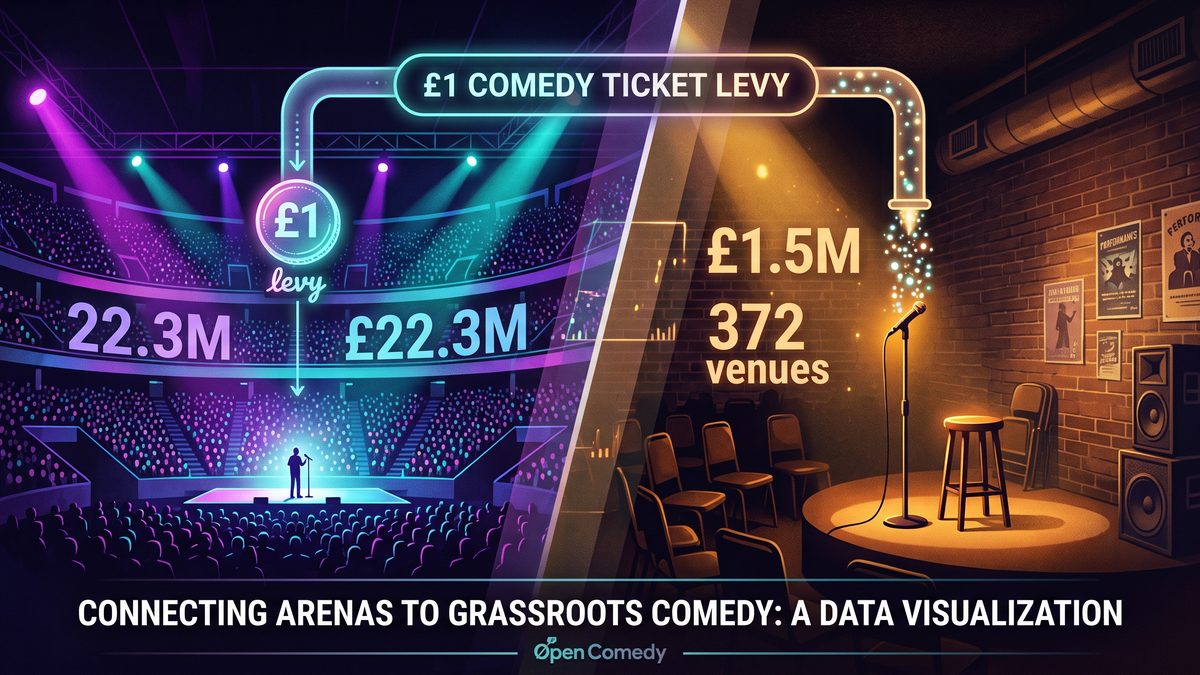
On 13 May 2025, Mark Davyd of Music Venue Trust sat in front of the Culture, Media and Sport Committee. He did the sum out loud. Music Week quotes him telling MPs: “There are already 22.3 million tickets on sale for arenas and stadiums in this country. That’s £22.3 million we could be spending right now.”
The money that actually arrived was a good deal smaller. NME put the full-year figures plainly. “Last year, it was expected that 50 per cent of stadium and arena gigs would be paying into the levy by the end of 2025.” It was not met. Just 8.8 per cent of shows in 2025 signed up, and a new deadline was set for 30 June 2026. That’s the machine British comedy has spent the last thirteen months formally asking to be plugged into, running at 8.8 per cent of the shows it was built for, with its deadline already moved once.
Is there a levy on comedy tickets?
No. There is no levy on comedy tickets anywhere in the UK, voluntary or statutory. Nobody has published a rate, a capacity threshold, a collecting body or a start date for one. The nearest thing that exists is a page on the Live Comedy Association’s own website. It sets out the music scheme as a model. “Live music gigs at arenas (capacities of 5,000 or more) are making a voluntary donation of £1 ticket to support grassroots music.” Five thousand seats is a long way from the rooms the money is supposed to reach, where the capacity conversation is usually about whether the back two rows can see past the pillar. The LCA wants “a similar scheme for live comedy” to do the same job: supporting “the next generation of comedians” and improving mental health. The page ends with an invitation to get in touch and discuss further, which tells you exactly what stage this is at.
The formal ask has gone up the chain, though. The letter the LCA published on 1 September was signed by 47 MPs. The fourth of its four requests is to “Explore extending the live music arena levy model to include live comedy”. A further 16 MPs backed the campaign but couldn’t sign, which Chortle explains is “normally because they have not been approached by a constituent”. Before that, the committee had already asked the question directly. Chortle’s February report lists “Whether the government would support a voluntary levy on arena tickets, with the proceeds going to help grassroots venues.” So far the comedy levy is a paragraph in other people’s correspondence, and nobody has put a name to the account it would be paid into.
Davyd’s £22.3 million against the £1.5 million that moved
Here’s the music scheme’s real shape. LIVE Trust launched in January 2025. Per Soundstock, it “collects a voluntary £1 levy on tickets for shows with more than 5,000 seats”. Since launch it “has secured more than six million ticket pledges, working with 10 promoters across more than 100 tours”. Phase One distributed £500,000 “to 372 venues, 211 shows and 81 festivals across the UK”. In July 2026 Phase Two was doubled by £1 million, “bringing the overall total of grants awarded to £1.5 million”. Youth Music, Help Musicians, Anthem Wales, Attitude Is Everything, Back Up Tech and Black Lives in Music joined the existing partners.
Do the division yourself, because nobody in a press release will. That Phase One £500,000 went to 664 recipients across the three categories. An even split would be £753 each, and it plainly wasn’t split evenly. Six million pledged tickets against the 22.3 million Davyd cited in committee is roughly a quarter. Even that comparison is loose: his figure was a snapshot of tickets on sale, and the pledges run across years and tours.
The participation number has also been quoted in two different units, which matters if you’re a sector thinking of copying the model. MusicRadar’s March 2026 piece says: “At present, only 30 per cent of tickets for 2026 shows are currently supporting the voluntary ticket contribution.” Tickets and shows are not the same denominator. One sold-out arena date can outweigh a month of mid-size rooms, so whichever unit makes the number look healthier tends to be the one that ends up in the quote. Music Venue Trust’s chief operating officer Beverley Whitrick, announcing the first delivery phase, was blunter about what the shortfall means on the ground:
Grassroots music venues cannot keep being expected to survive on goodwill and admiration alone. If the UK music industry is serious about protecting the talent pipeline, then it has to get serious about the economics that underpin it.
What £753 buys in a 60-seat room
Music Venue Trust’s first slice was, per NME, “a £200,000 funding allocation from The LIVE Trust to help stabilise and rebuild the sector”. It is split across named programmes: Raise The Standard, Stay The Night, Feel At Home, Off The Grid and an Emergency Response Hardship Fund. Equipment, artist accommodation, backstage, energy bills, and cash for people in trouble. Stay The Night is the accommodation one, which in comedy currently translates as the promoter’s spare room and a cat that sits on your case. Not one pound of it went to a comedy room, because it isn’t comedy’s money.
Translate those sums into the kind of venue a comedy levy would be aimed at and the ceiling gets visible fast. A few hundred quid covers a PA repair, a month of a stagehand’s shifts, or the accommodation cost of one touring act for a week, and it runs out well before anyone gets paid to perform. The LCA’s own sector survey, published on 4 February 2026, sets out the demand side. Average earnings were £21,143 in 2025, “down from £26,778 the year before”, and gigs per week fell “from 3.2 per week to 2.5 per week”. A grant programme at music’s current scale would not restore a single comic’s income to where it was. Scotland’s own funded sector review found the same missing middle between open mics and paid work.
The promoter side is squeezed from the other direction: the survey found “31% of promoters sold between 71-90% of their tickets, down from 45% in 2024”. Anyone running a room at £20 a head can work out what a ten-point drop in load factor does to a Saturday. Whatever a small infrastructure grant buys, it doesn’t put anyone in the empty fifth of the room, and the bar take walks out with them.
Nobody has said who would hold the money
Music’s levy has a named trust, named partner organisations and a published phasing. Comedy has none of that: no distributing body, no application process, no panel, no stated split between venues, festivals, promoters and performers. Nobody has said in public who would sign the cheques.
That gap is not academic in a sector that has just watched a festival charity collapse owing money to acts. The Leicester Comedy Festival liquidation left comedians on the creditors list against nil assets. Any comedy levy would be handing pooled ticket income to somebody’s governance structure. The sector’s own instinct so far has been to pass the hat instead.
The data problem is next. The LCA estimates the sector is worth £1 billion a year. The culture committee’s own chair, Dame Caroline Dinenage, acknowledged the sector is “fragmented”, which limits how much any survey can tell you. Nobody has published how many arena and stadium comedy tickets the UK sells in a year, so nobody can honestly say what a £1 comedy levy would raise, and any figure you’ve seen quoted is somebody’s guess with a suit on. That £1 billion, remember, is carrying everything from panel-show production down to a Tuesday open mic in a function room with the fire door propped open.
The same minister is on both sides of this letter
The neatest detail in the whole story is that one minister is simultaneously threatening music with legislation and suggesting comedy build the voluntary version. In March 2026, on the music side, Ian Murray said: “Live Nation, given its hugely influential position in the market, could make a major positive impact if it changes its stance. I urge them to reconsider and step up to help the next generation of talent.” He added that the government is “prepared to explore legislative options to ensure the sustainability of our world-leading live music industry”. He would “reiterate this message to those promoters who can make a real difference”. That same month, his progress letter on live comedy encouraged the comedy sector to consider a voluntary levy on arena ticket sales, along music-industry lines. It also confirmed comedians would get input on upcoming Arts Council England changes, and said he was looking for a freelance champion. It recorded that the previous £7 million of Edinburgh Fringe support had ended.
Dinenage’s assessment of that letter, as reported by Chortle, was that “the Government’s policy on live comedy is still very much ‘work in progress'”. Her original six-page letter to the then arts minister Chris Bryant in August 2025 had set the terms. She “suggested that arena gigs could add a voluntary levy to tickets that would feed back into the grassroots circuit”. She wanted “increased engagement by DCMS with the sector” as a first step. Arts Council England should also revisit “how it considers and funds live comedy”. At the time, LCA co-chair Jessica Toomey called it “a landmark moment for UK live comedy”. On the September letter she said “The support we are receiving from politicians from across the political spectrum is fantastic”.
There is at least a permanent vehicle now. An All-Party Parliamentary Group for Comedy was initiated by the trade body Craft, which provides the secretariat. Officers were elected at an inaugural meeting before recess began on 16 July 2026. The chair is Richard Quigley, Labour MP for Isle of Wight West, a fish-and-chip shop owner and occasional stand-up. That is either the perfect CV for this brief or a setup line, depending on your mood. Craft chair Lu Jackson said the group would “give our industry a permanent, official presence in Parliament”. It would create “a dedicated space where the ecosystem’s pressing challenges can be brought forward”. And yes, somebody said ecosystem out loud in a sentence about comedy, and nobody stopped them.
Music’s revised deadline of 30 June 2026 has now passed. I could not find published figures confirming whether the 50 per cent participation threshold was met. So comedy is queuing for a mechanism whose first full year reached 8.8 per cent of the shows it was designed to catch, without yet knowing how many arena comedy tickets there are to levy. Counting those is somebody’s afternoon with a spreadsheet and a list of tour dates, and nobody has put their hand up for it.
