
Comedy News Filed 22 Oct 2026 · 05:37
CRAFT’s Back British Comedy Letter: The Five Budget Asks That Matter
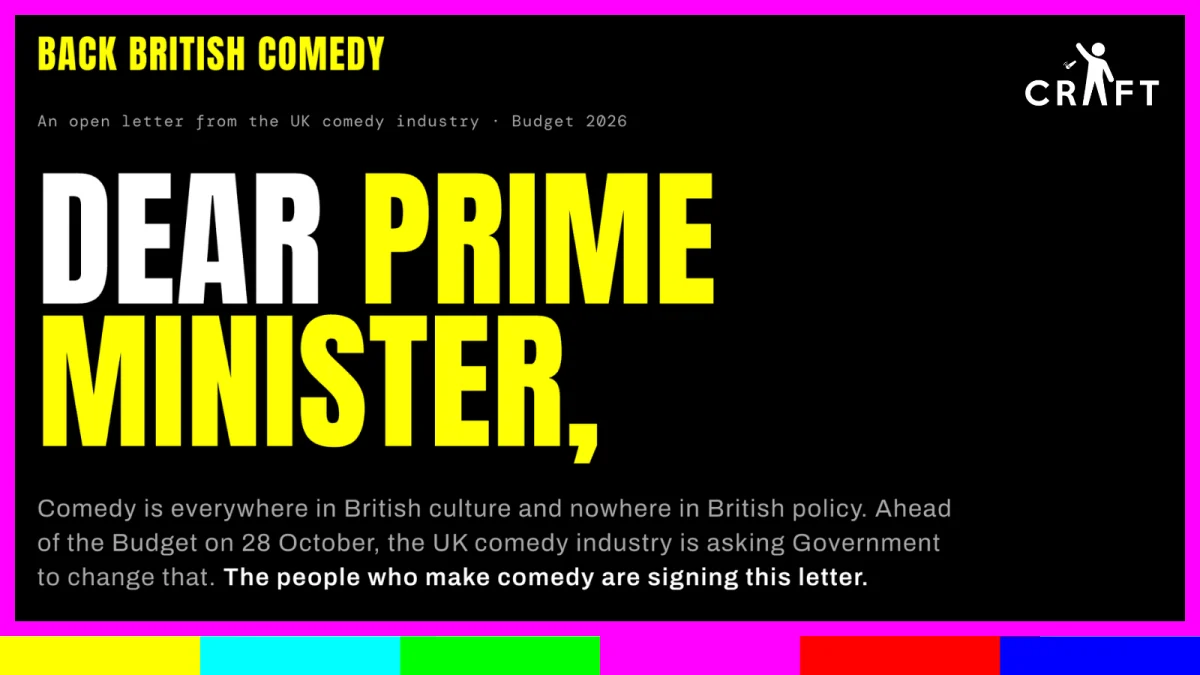
Arts Council England spent £946.9m last year and, by CRAFT’s own count, £0 of it was attributed to comedy. That figure is doing most of the work in an open letter to the Prime Minister asking Government to back British comedy. Chortle reported on 12 October that it had 669 signatories. Jason Manford, Joe Lycett, Iain Stirling, Daniel Sloss, Kerri Godliman and Alex Horne are on it, along with Sir Stephen Fry, Miriam Margolyes and Bill Bailey. Chancellor John Healey delivers his Budget in the House of Commons on 28 October, the date everyone involved in this keeps repeating back at you.
The signatory list is the bit that travels, and it’s the least useful bit if you run a 60-seat room above a pub. The letter carries five specific asks, and two of them would change what that room costs to keep open. CRAFT, which organised the letter, has put the asks on a page called Back British Comedy. Chortle says the body is supported by 25 parliamentarians from across the parties. The page is blunt about the framing: “Comedy is everywhere in British culture and nowhere in British policy.”
The five asks, and the two that change what a room costs
First on the sheet is “Business rates relief for live comedy venues at parity with pubs and music venues”. That’s the only ask on the list that arrives as money, or rather as money not leaving. CRAFT’s first listed ask is business rates relief for live comedy venues at parity with pubs and music venues. Then there’s the definition problem. Can the Treasury be bothered to write a definition of “live comedy venue” that doesn’t accidentally hand relief to every boozer with a microphone in a cupboard? Honestly, that’s a hard one.
Second is “Official codes for comedy as a job and as an industry.” This one sounds like filing, and it is filing. It’s also the ask I’d back to matter longest. CRAFT asks for official codes for comedy as a job and as an industry, which Chortle summarised as classification so comedy can be counted. Comedy therefore turns up in nobody’s dataset when funding is being carved up. CRAFT’s own figures put 84 per cent of comedy professionals on less than £30,000 a year from comedy. The same figures put 65 per cent under £12,570, the personal tax allowance. Those are CRAFT’s numbers rather than an official survey’s, which is precisely the circle the code ask is trying to break.
The other three are recognition and access. CRAFT wants comedy recognised as an artform and category by all four UK arts councils. Chortle boiled that down to “Named recognition, where comedy becomes an artform and category, not a genre.” It wants comedy named in culture funding, in schools, in NHS social prescribing and in research and innovation grants. And on its Back British Comedy page, CRAFT asks for government in a room at No.10 with a cross-section of the comedy industry. Per Chortle, that comes with a meeting before the Budget announcement and an impact assessment.
CRAFT’s pitch for all of it, in the version Radio NewsHub quoted on 12 October, is that none of this amounts to a fight:
This is not a political ask, it is an administrative correction with an economic return.
Which is a sentence written by somebody who has read the room. The economic return CRAFT points at is the money it says comedy already pays in through VAT, income tax, National Insurance, business rates and corporation tax. It also claims the UK’s top two comedy festivals delivered around £45 million in net benefit to Britain in 2026. Going the other way, Chortle reports CRAFT’s count of under £15 million in direct public investment over 25 years. That is an average of £576,000 a year across the whole lot. Both sets of numbers are CRAFT’s own, reported by Chortle, and they read as advocacy. When public money does reach comedy it tends to arrive in small, specific lumps.
£1m per broadcast hour, and the half-hours that fall under it
The ask that decides whether anyone in television cares is a threshold. The Knowledge reported on 13 October that Craft has requested reform to the threshold of the Audio-Visual Expenditure Credit for film and TV. The current high-end television threshold is £1m per broadcast hour, or £420,000 to £450,000 per half-hour. Craft’s case is that the figure excludes a swathe of the form: mid-budget sitcoms, sketch shows, quiz formats and short-form animations.
Worth being clear, because the two asks get mashed together in the retelling: this one has nothing to do with your gig. The AVEC request The Knowledge reported on 13 October concerns the threshold of the Audio-Visual Expenditure Credit for film and TV. What the threshold does is set a floor most British comedy formats can’t reach without dressing up as prestige drama. That’s a strange incentive to hand a trade whose best work is frequently four people in a kitchen set with one good door.
Can you still add your name to the letter?
Yes. CRAFT’s Back British Comedy page still carries an “Add your name” prompt, and still frames the campaign as running ahead of the Budget on 28 October. The total keeps moving. The 669 figure is Chortle’s, counted on 12 October. The same piece describes the signatories as almost 700 comedians and industry figures once the headline names are folded in. Sign it this week and you’re joining a number nobody will be able to quote accurately for more than about a day.
A meeting was announced too: The Knowledge reported on 13 October that Craft will join Comedy All-Party Parliamentary Group chair Richard Quigley MP for a meeting with Number 10. CRAFT’s own line on the odds, quoted by Radio NewsHub, is relentlessly upbeat: “Everything is a no until it is a yes; we would be glad to bring the industry to No 10 to make it a yes.”
For a sense of how long this door has been shut, look at CRAFT’s earlier open letter to Andy Burnham, the one Beyond The Joke published in July. It requested an urgent meeting on behalf of the comedy industry. It also noted that comedy has never been given a seat on the Creative Industries Council since its formation in 2011. That’s a different letter from this one.
Healey stands up on 28 October, and the paragraph worth reading twice will be the business rates one. Watch whether it names anything past pubs and music venues. The rest of the letter is a slow filing job, won in statistics committees rather than at a podium, and Chortle counted 669 signatories as of 12 October. CRAFT’s Back British Comedy page invites you to add your name to the letter, which is the entire scale of your contribution between now and the Budget on 28 October. Whatever Chancellor John Healey says when he is due to deliver his Budget in the House of Commons on 28 October, you can see what is on in our UK open mic listings, browse comedy venues, and look for spots on the gig board.
Sources
- Chortle: Almost 700 comedy pros call for policy change (12 October 2026)
- CRAFT: Back British Comedy
- The Knowledge: Comedy talent and indies lobby for financial support (13 October 2026)
- Radio NewsHub: Stephen Fry and Miriam Margolyes join calls for Burnham to fund comedy in Budget (12 October 2026)
- Beyond The Joke: Craft UK Sends Open Letter to Andy Burnham (23 July 2026)
